Your next system is one prompt away.
Copy the prompt, change the last sentence to describe your business, and paste it into your agent.
Drubricks is a free starter kit on Drupal 12. Tell your AI agent what the system is for, and it builds one from proper Drupal parts: data, access rules, screens, demo data and tests.
Based on Drubricks (https://github.com/drubricks/drubricks) build me a system to manage the teachers and clients of a language school.
Video
A walk through the starter: the apps, the screens and how an agent builds on it.
What you start from
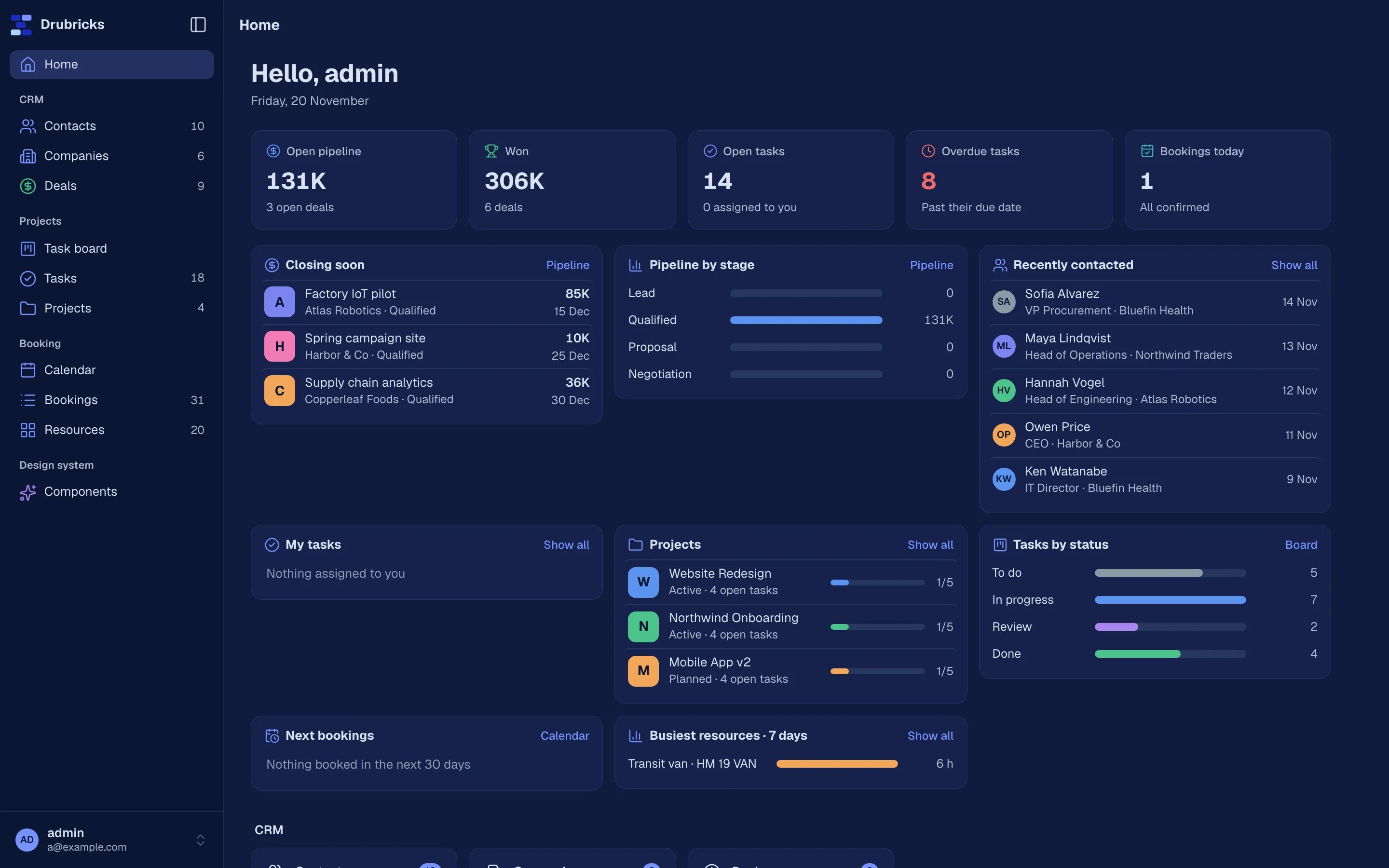
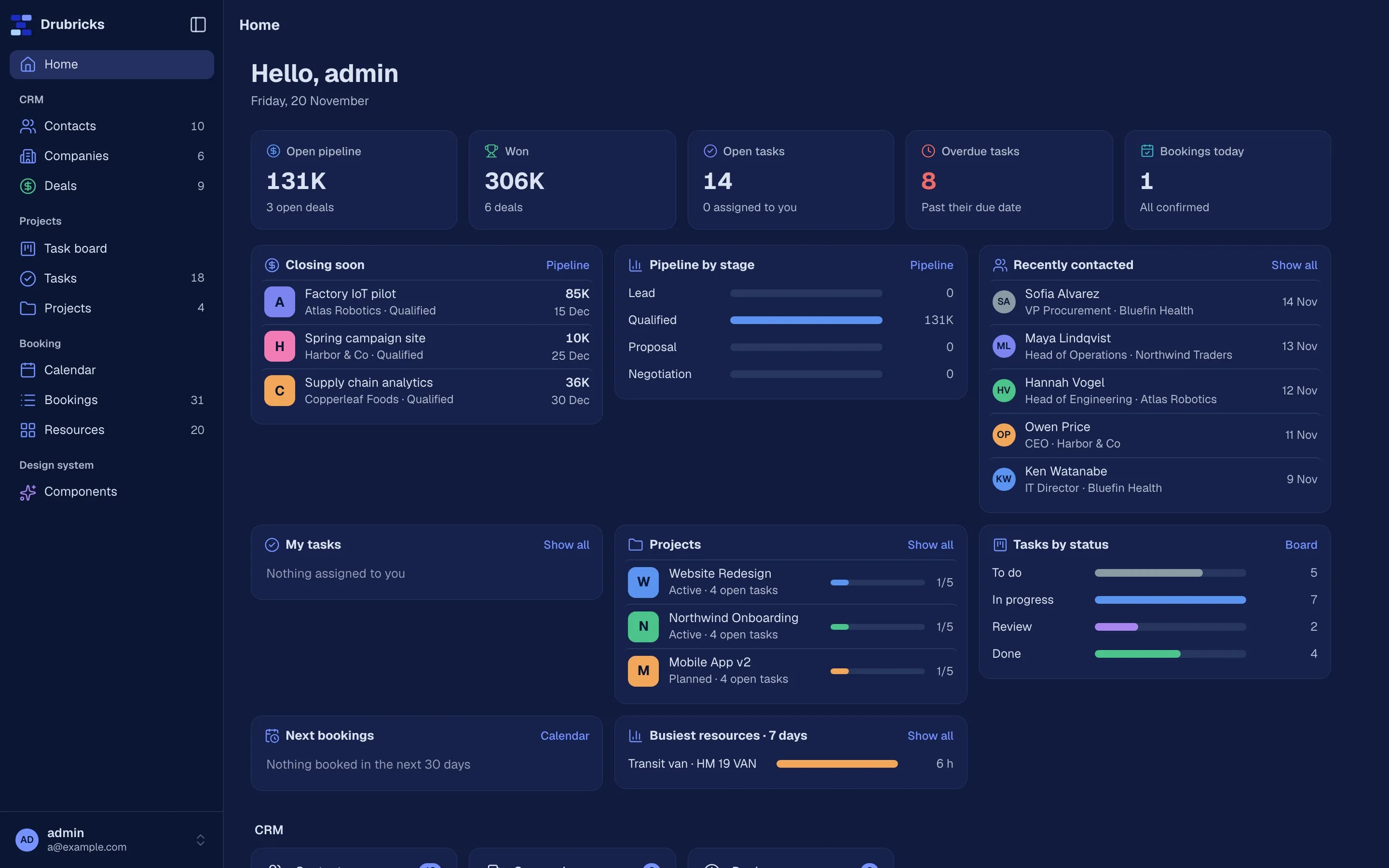
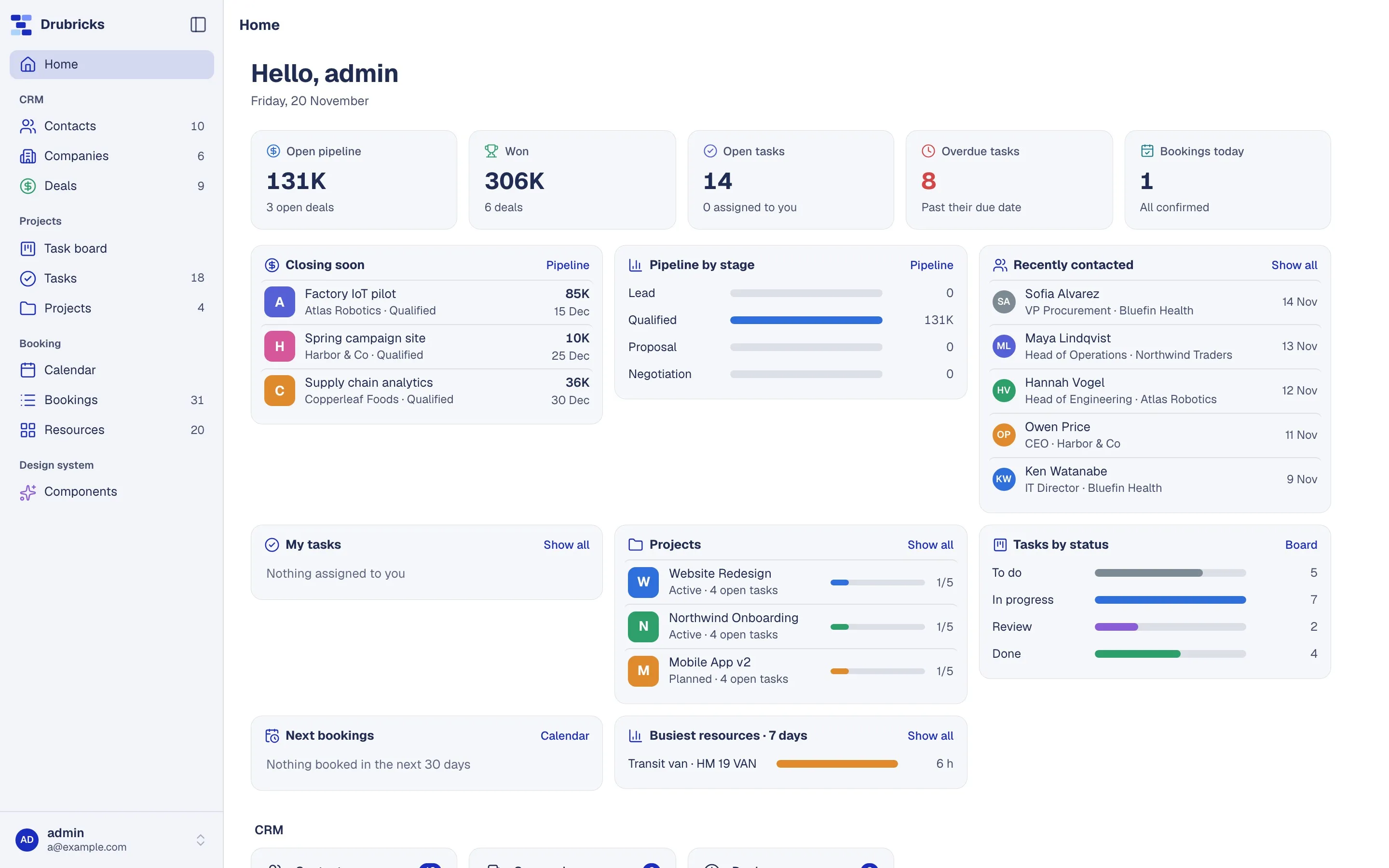
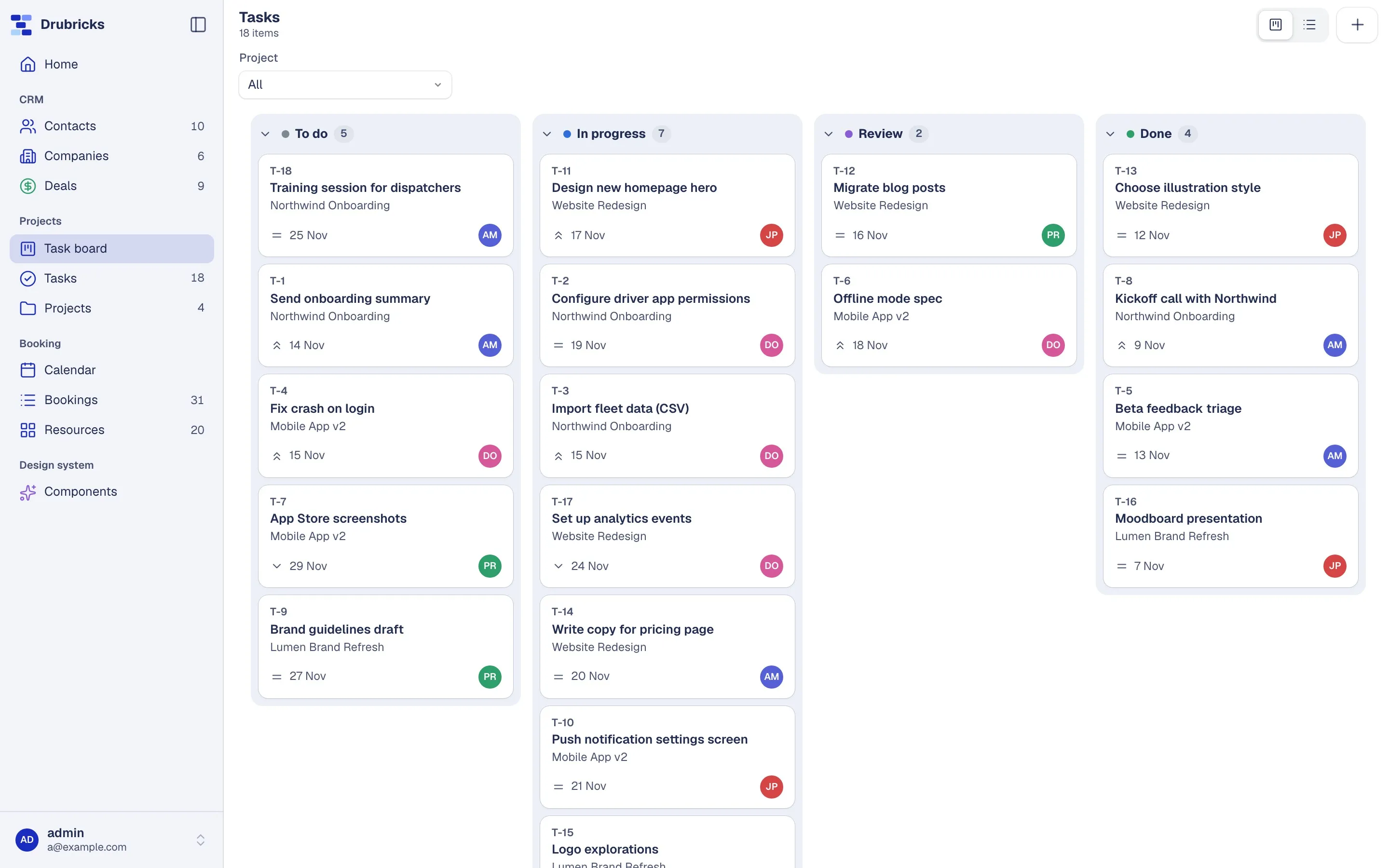
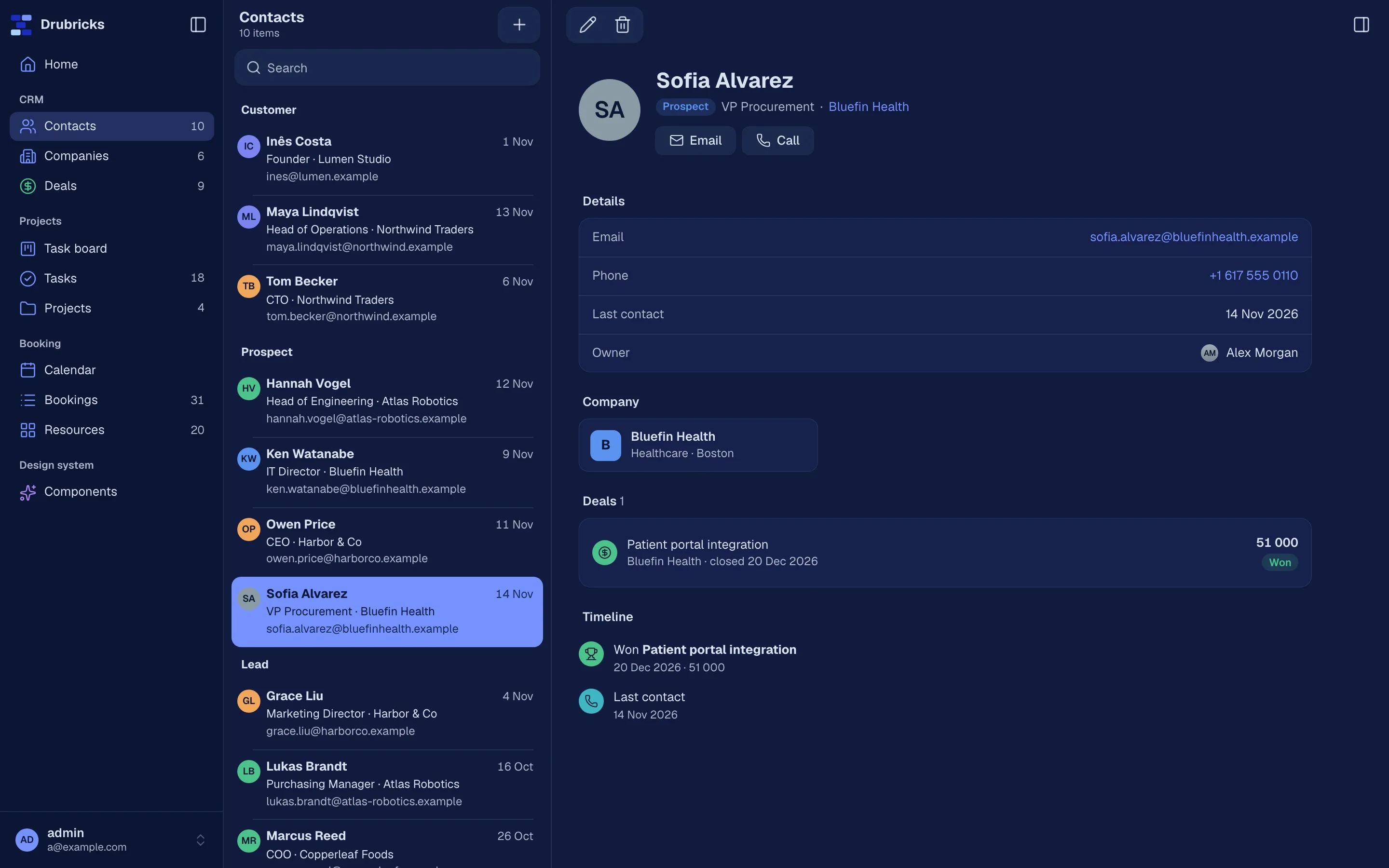
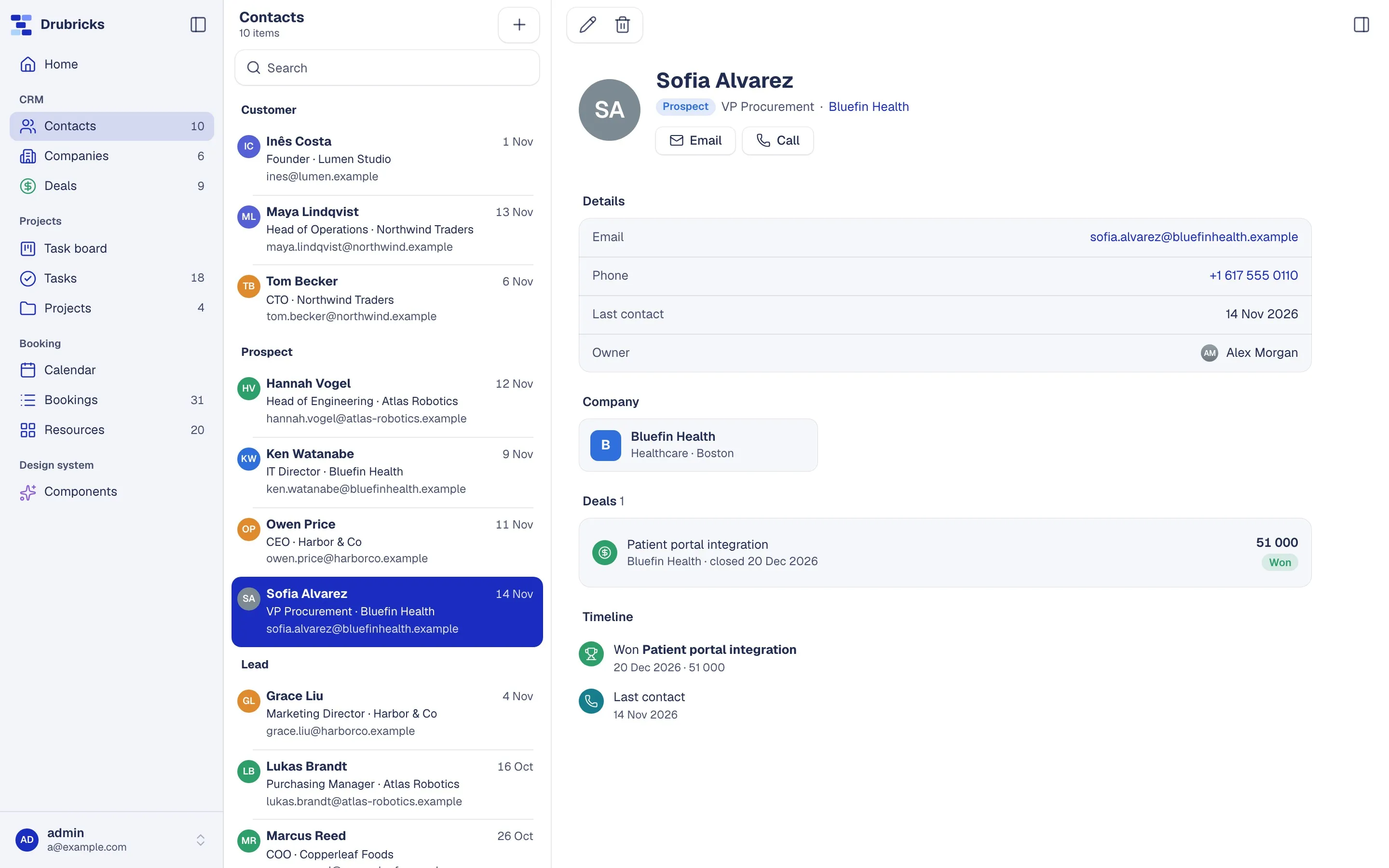
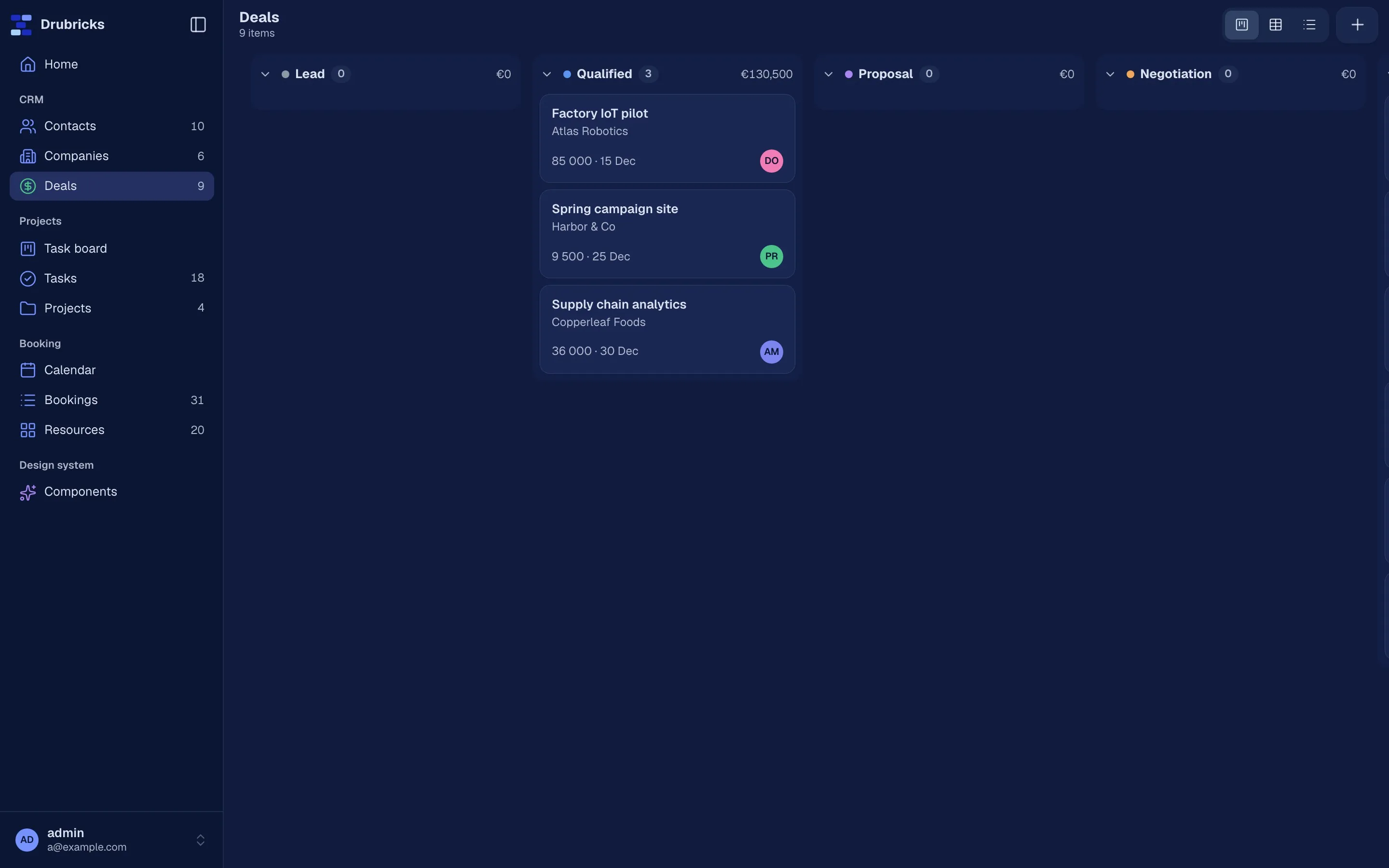
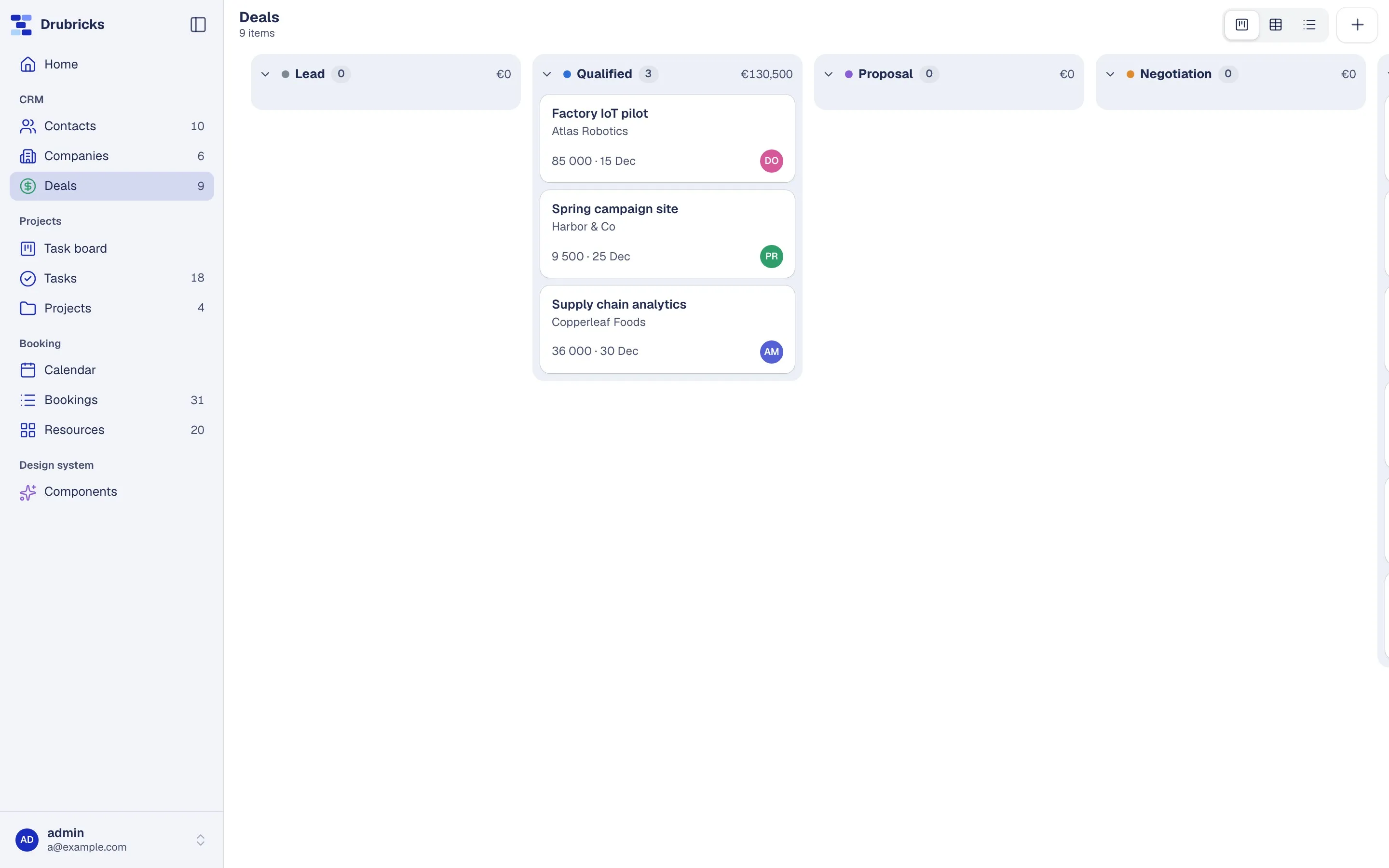
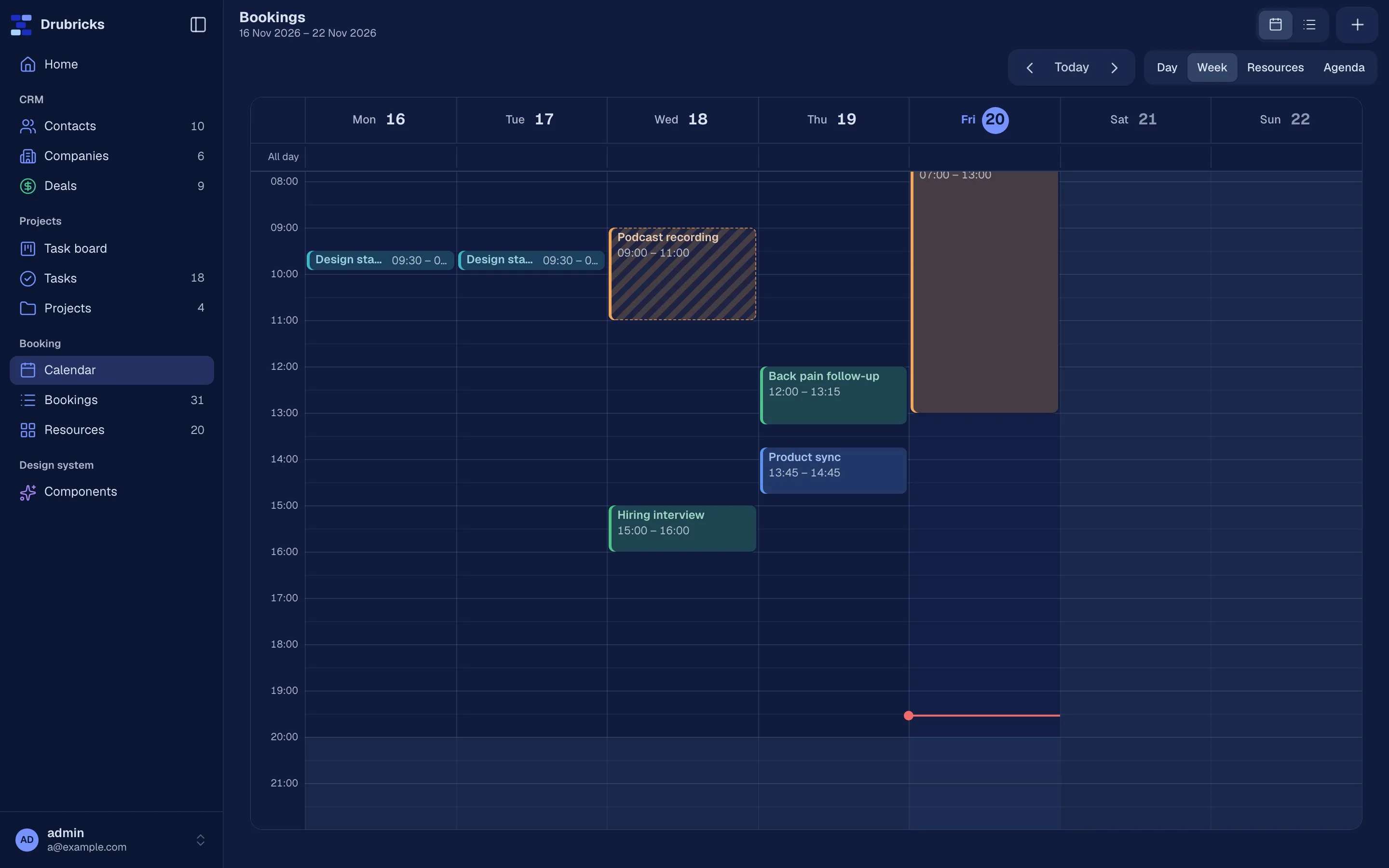
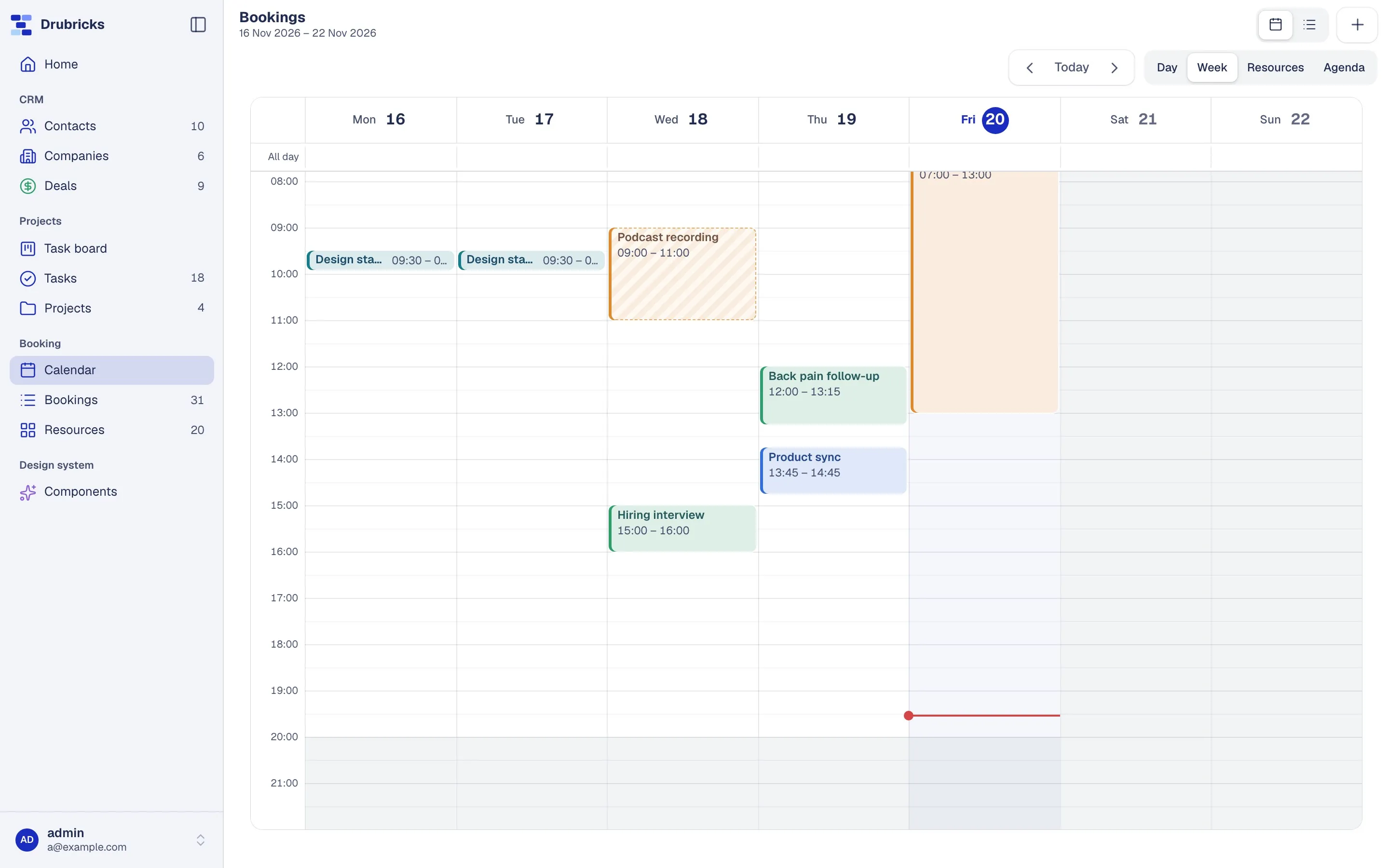
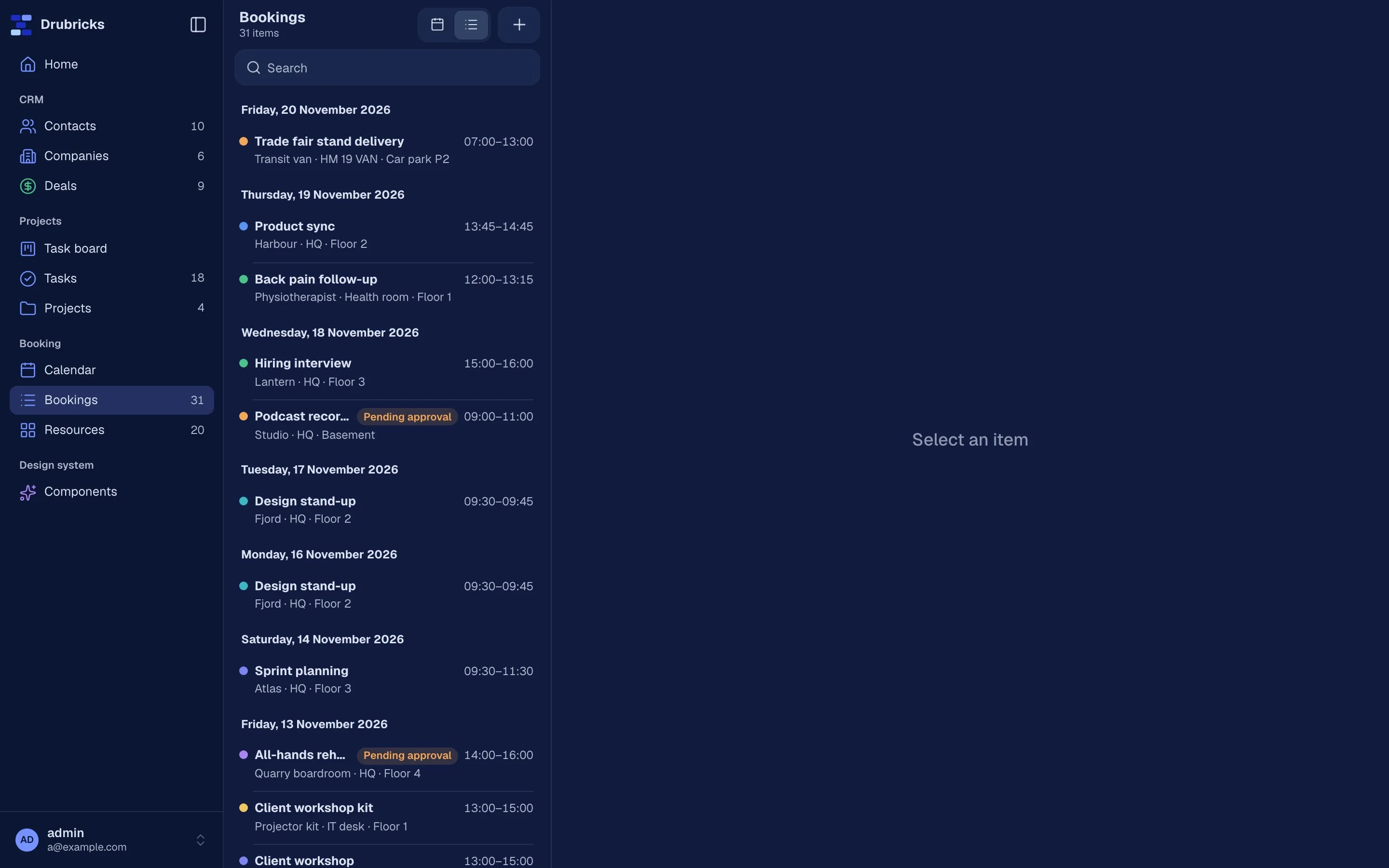
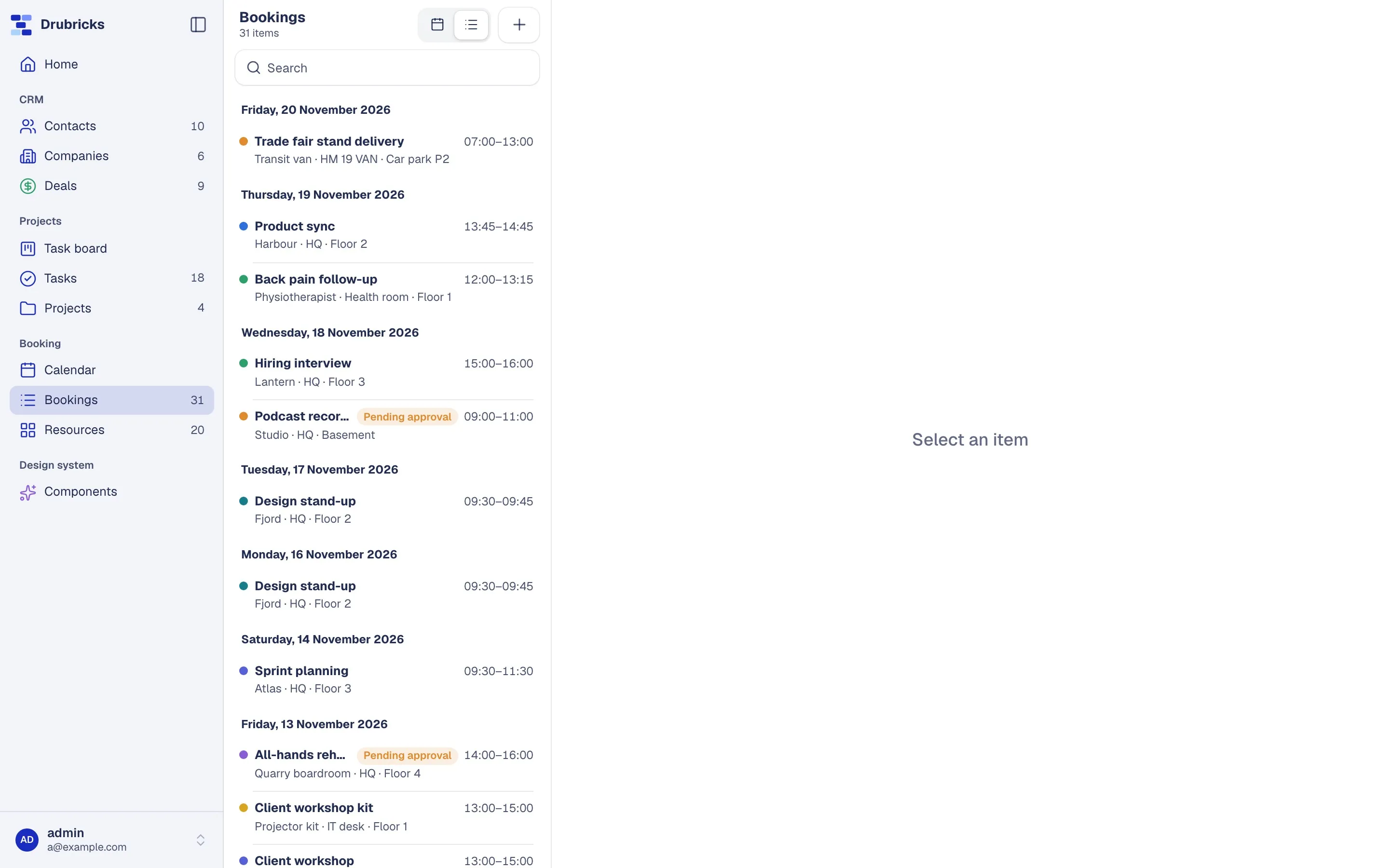
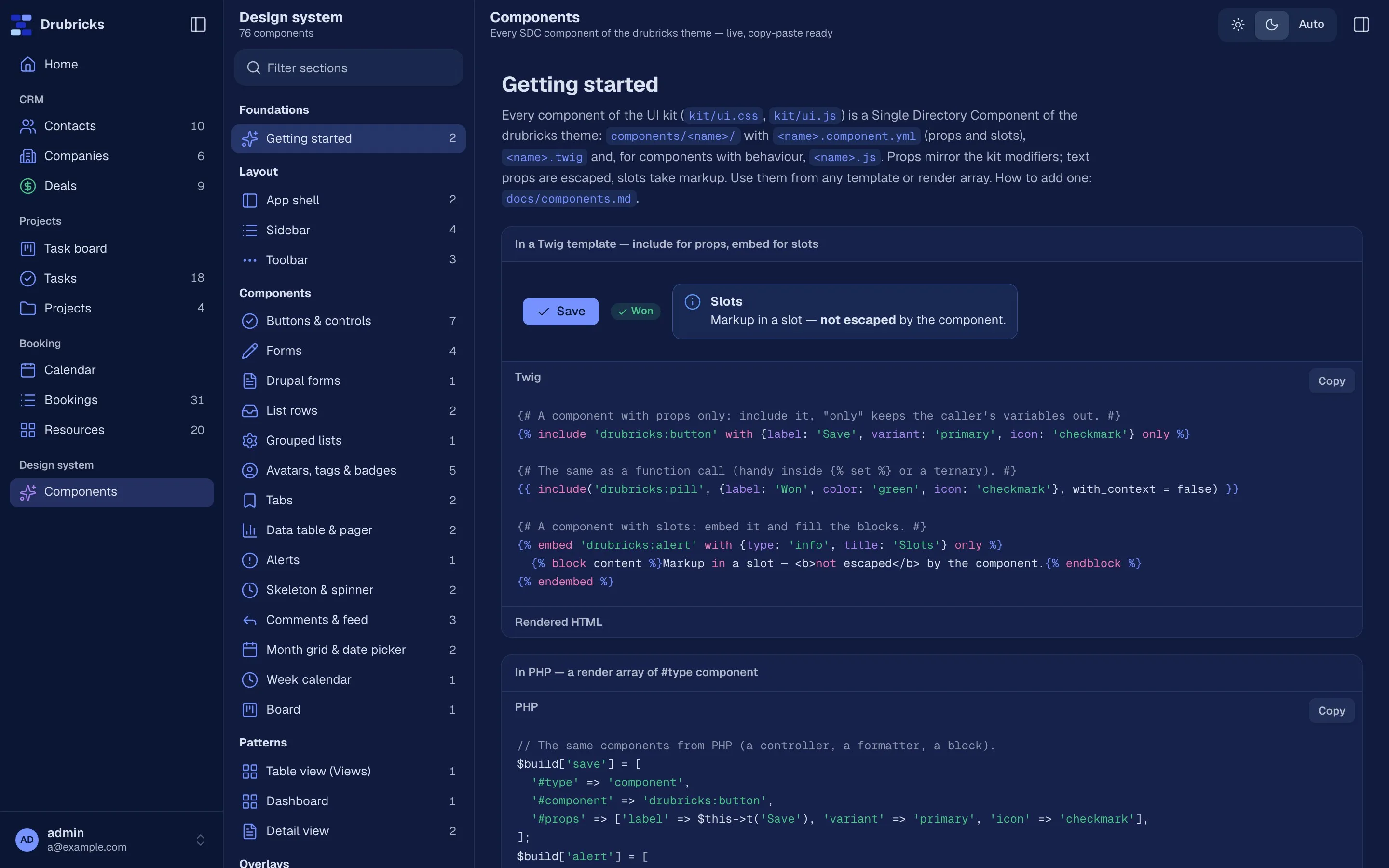
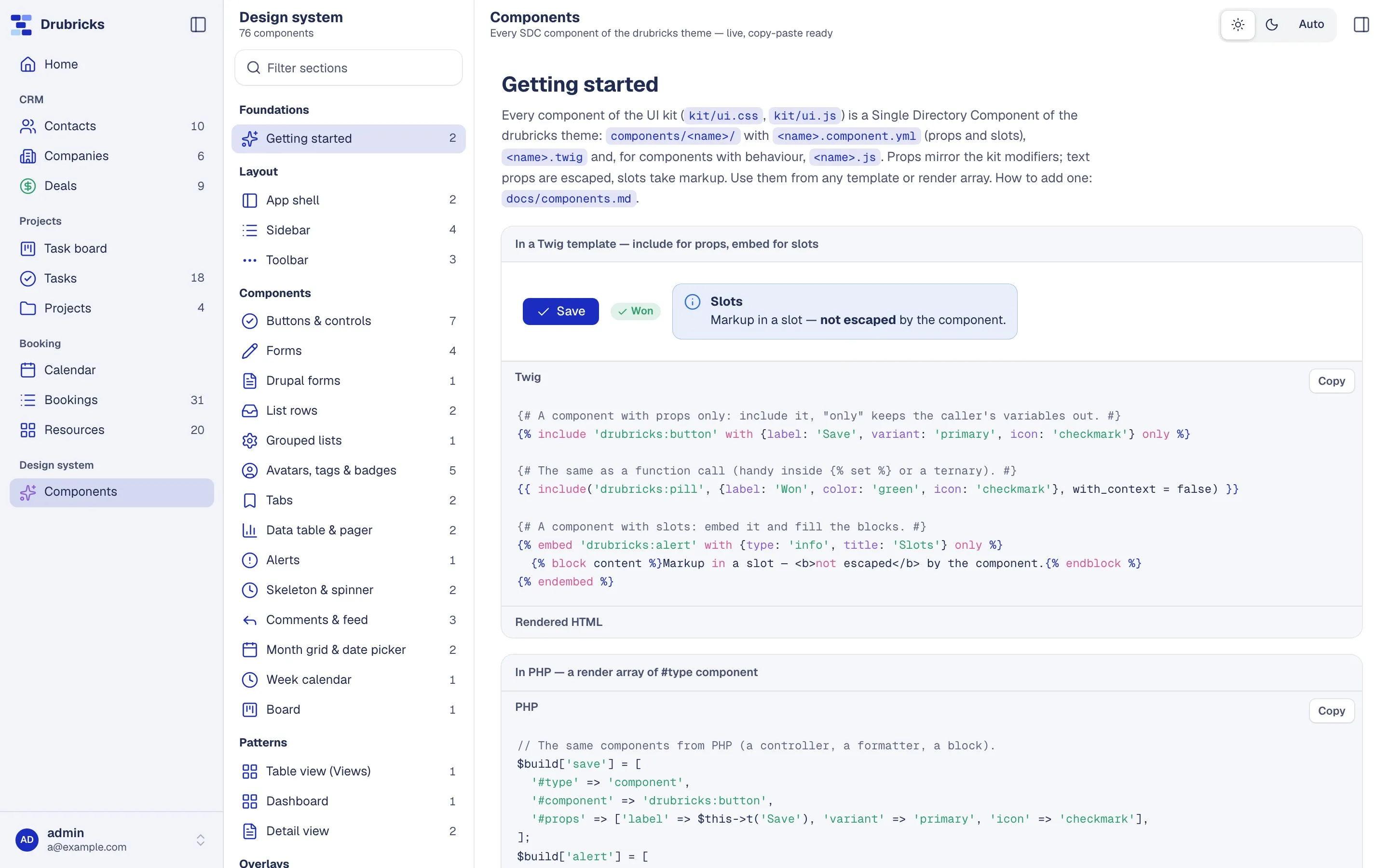
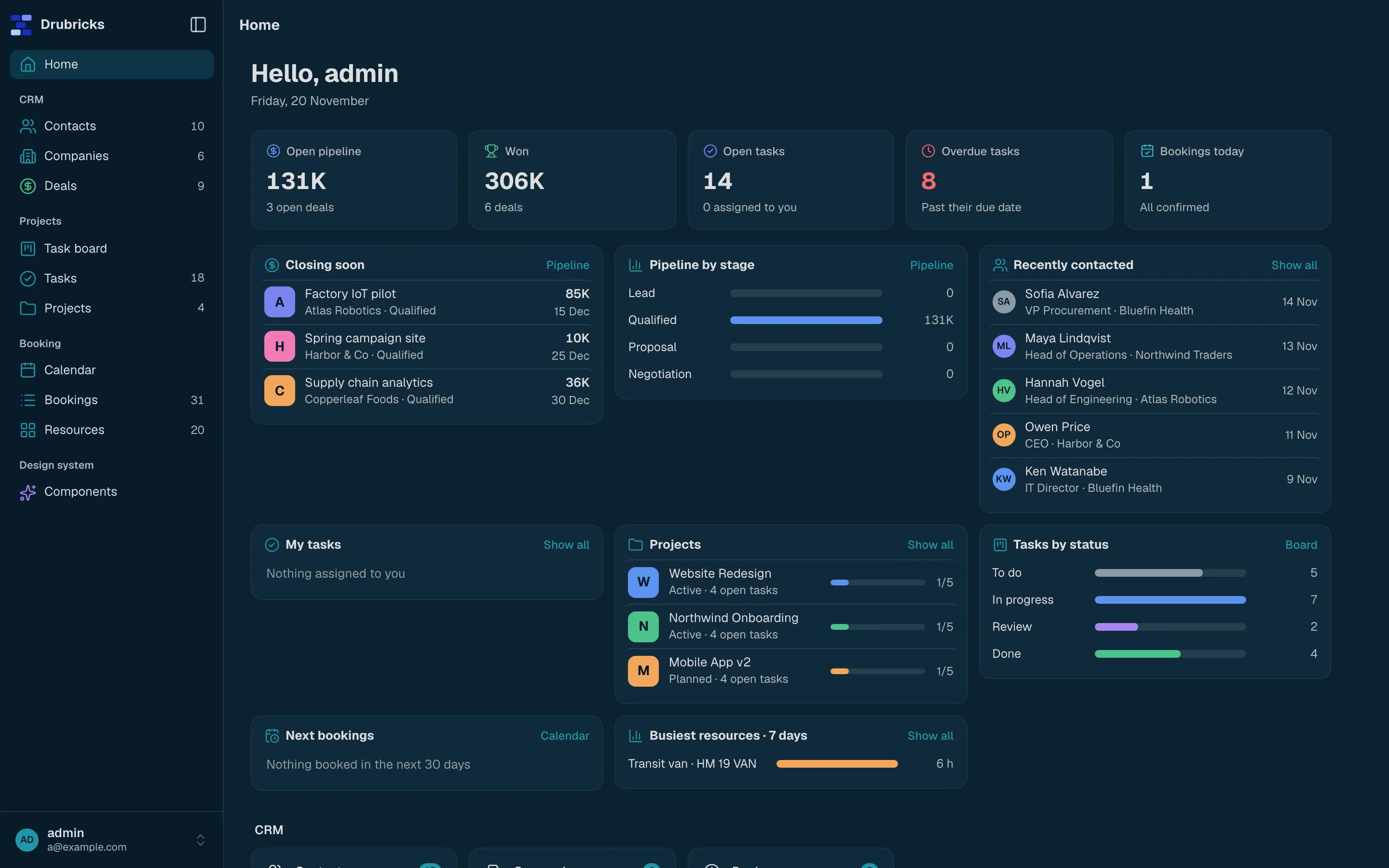
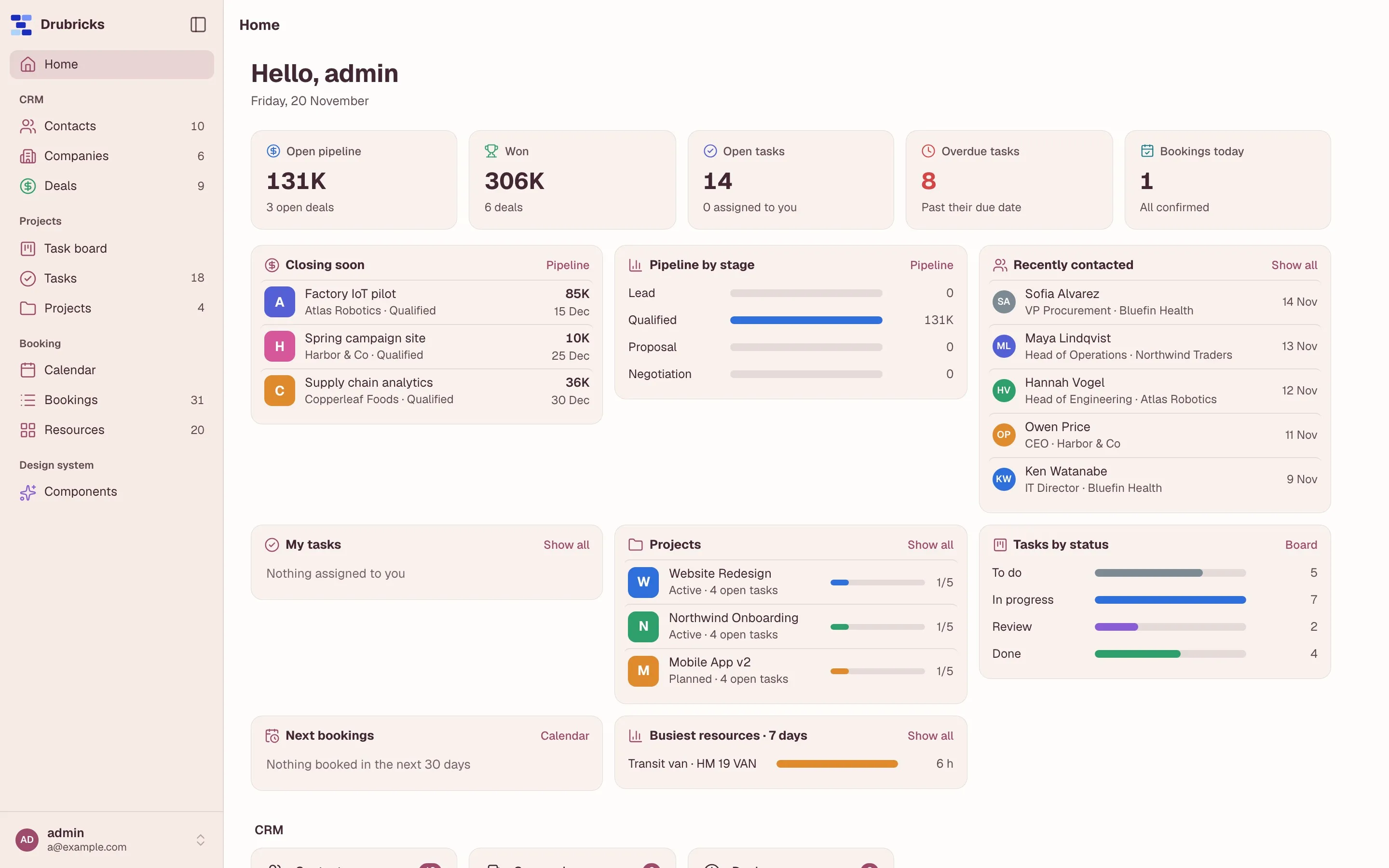
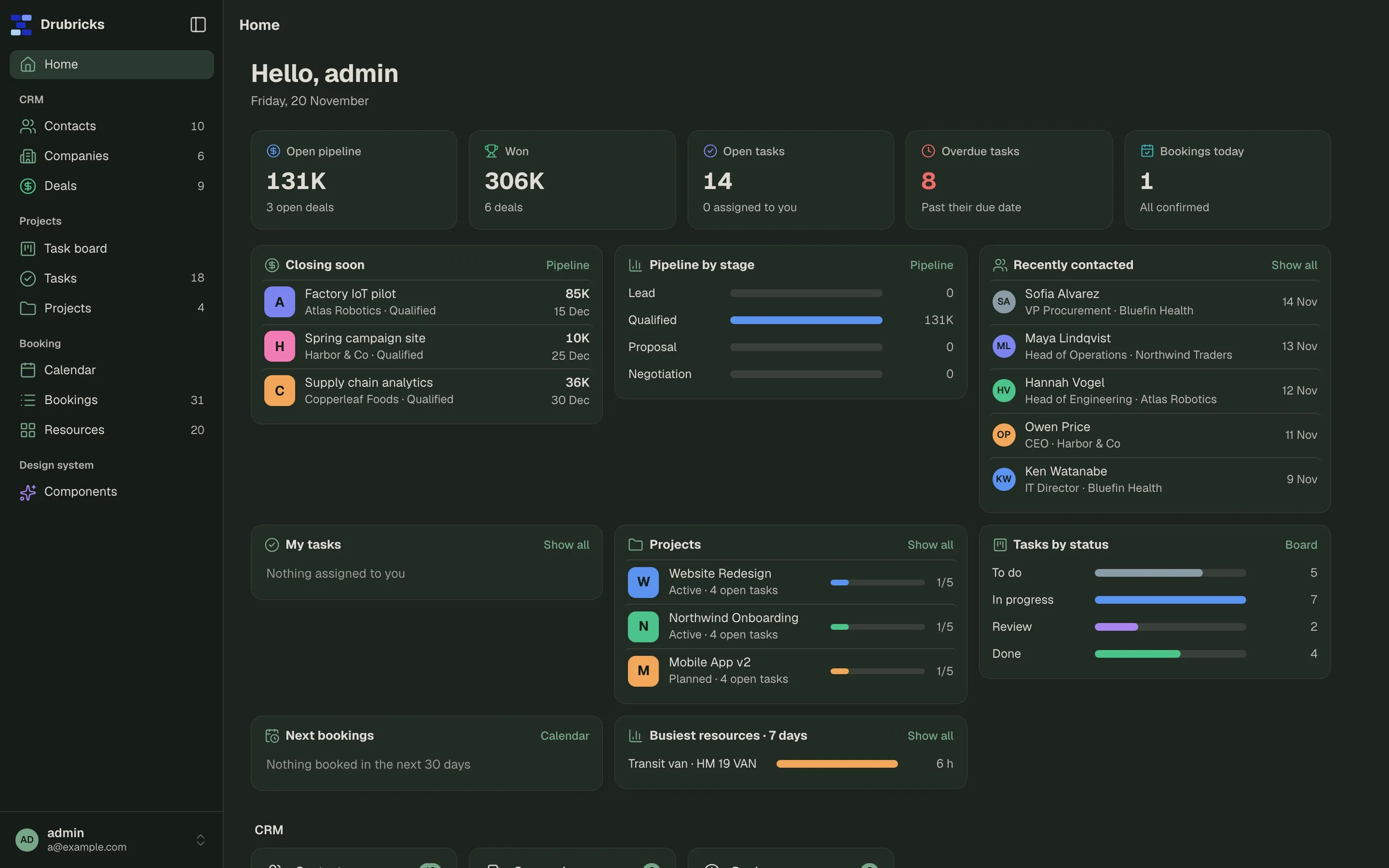
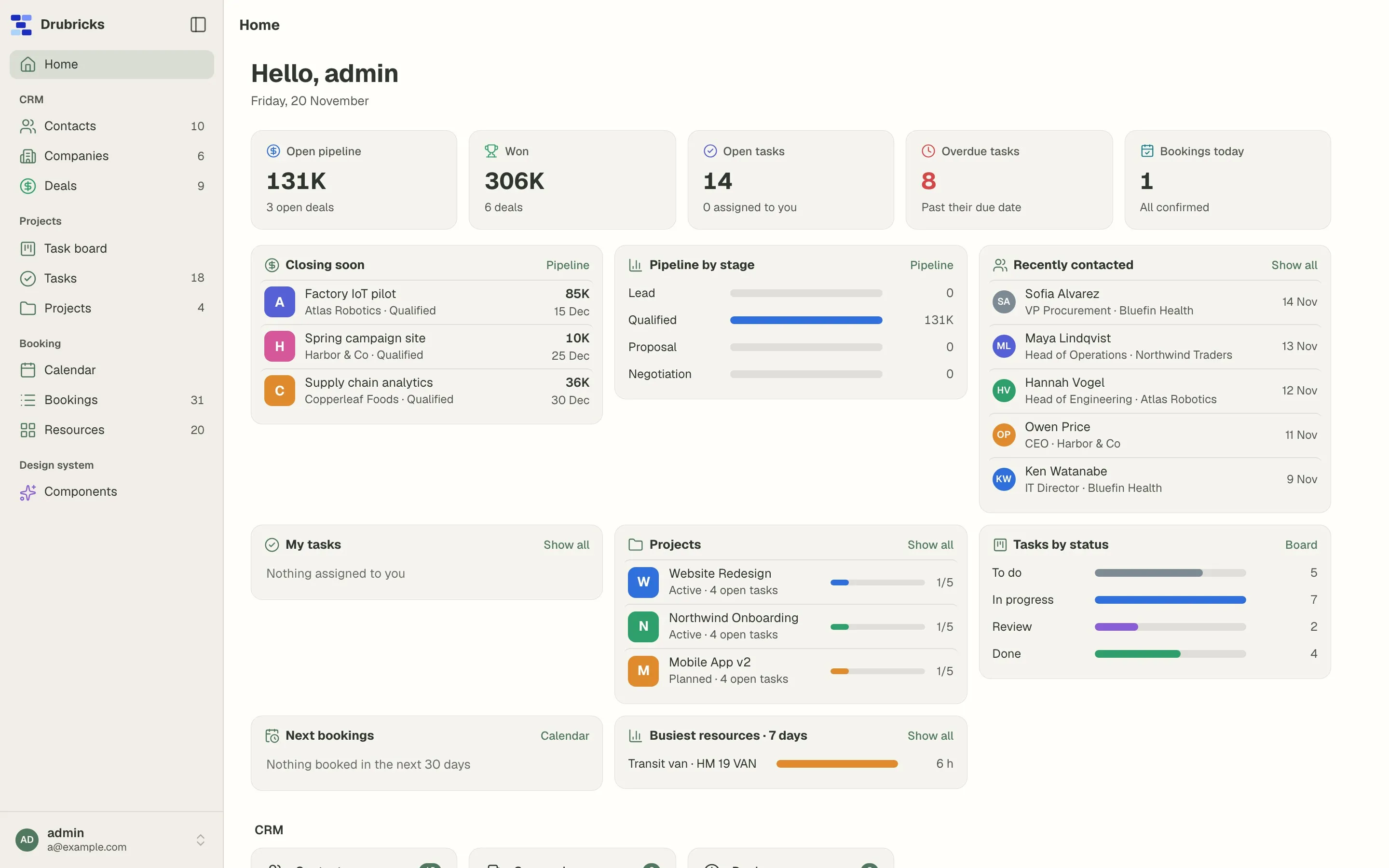
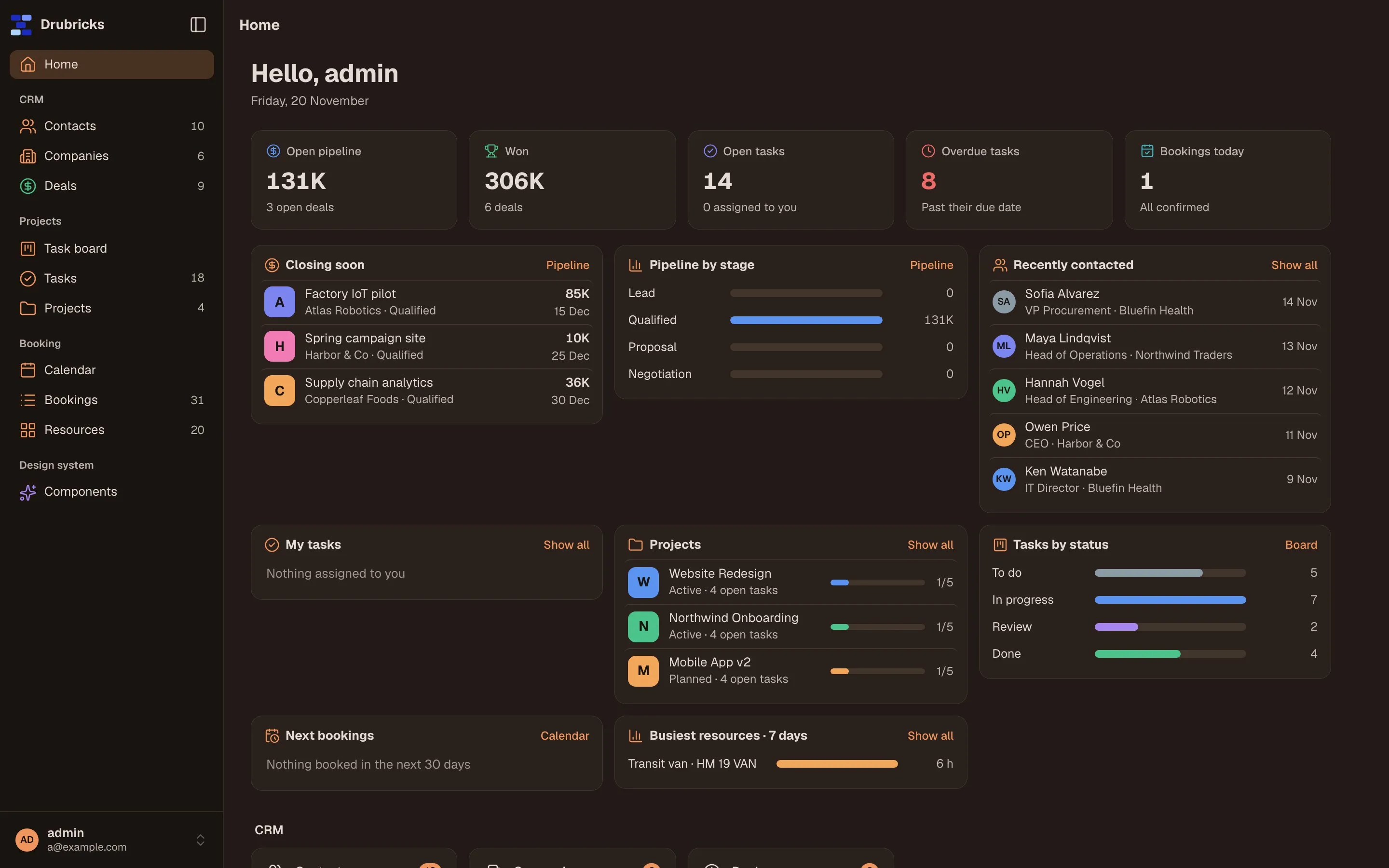
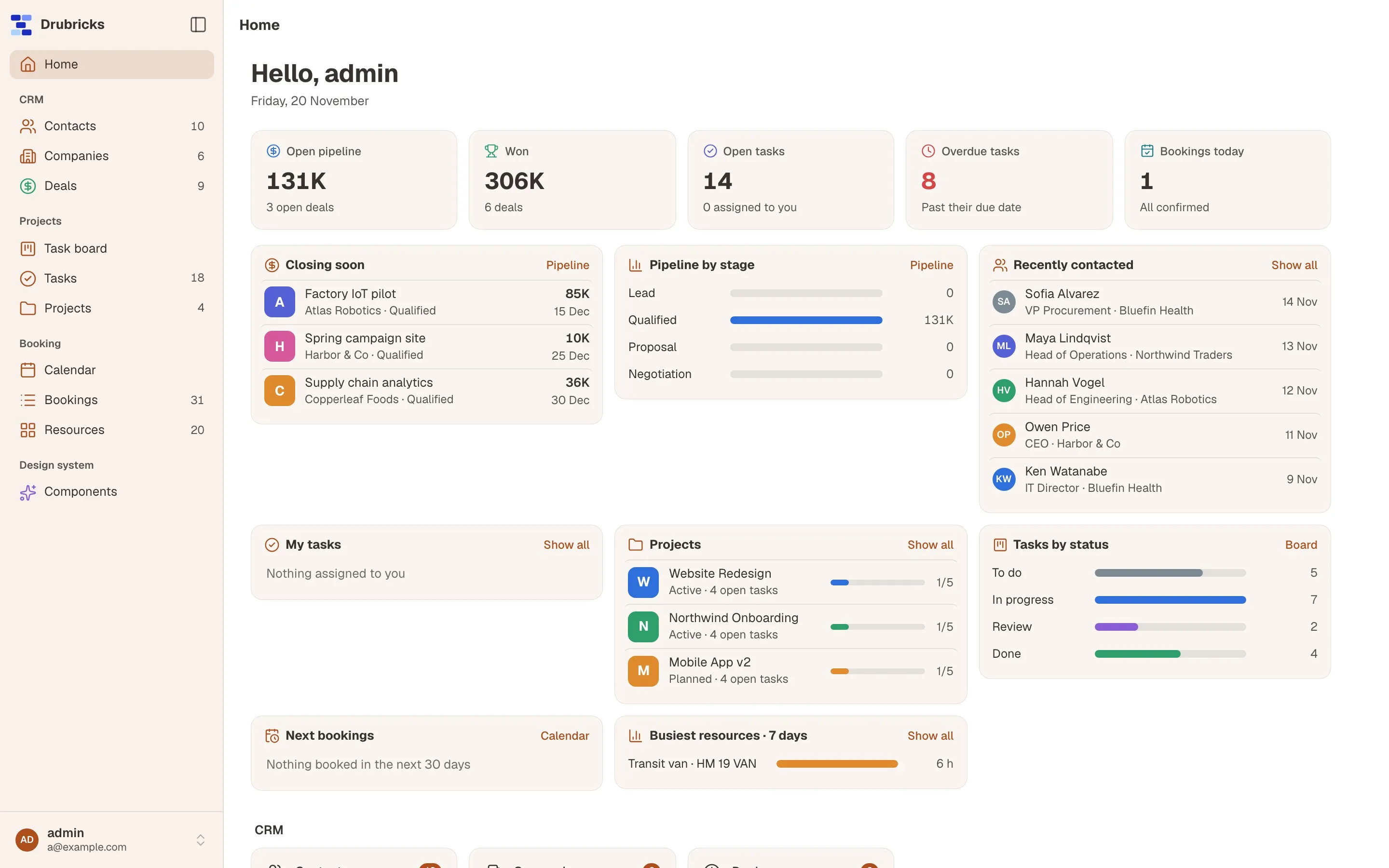
This is the starter with its three example apps installed. Your system gets the same shell, the same components and the same screens, in its own records.
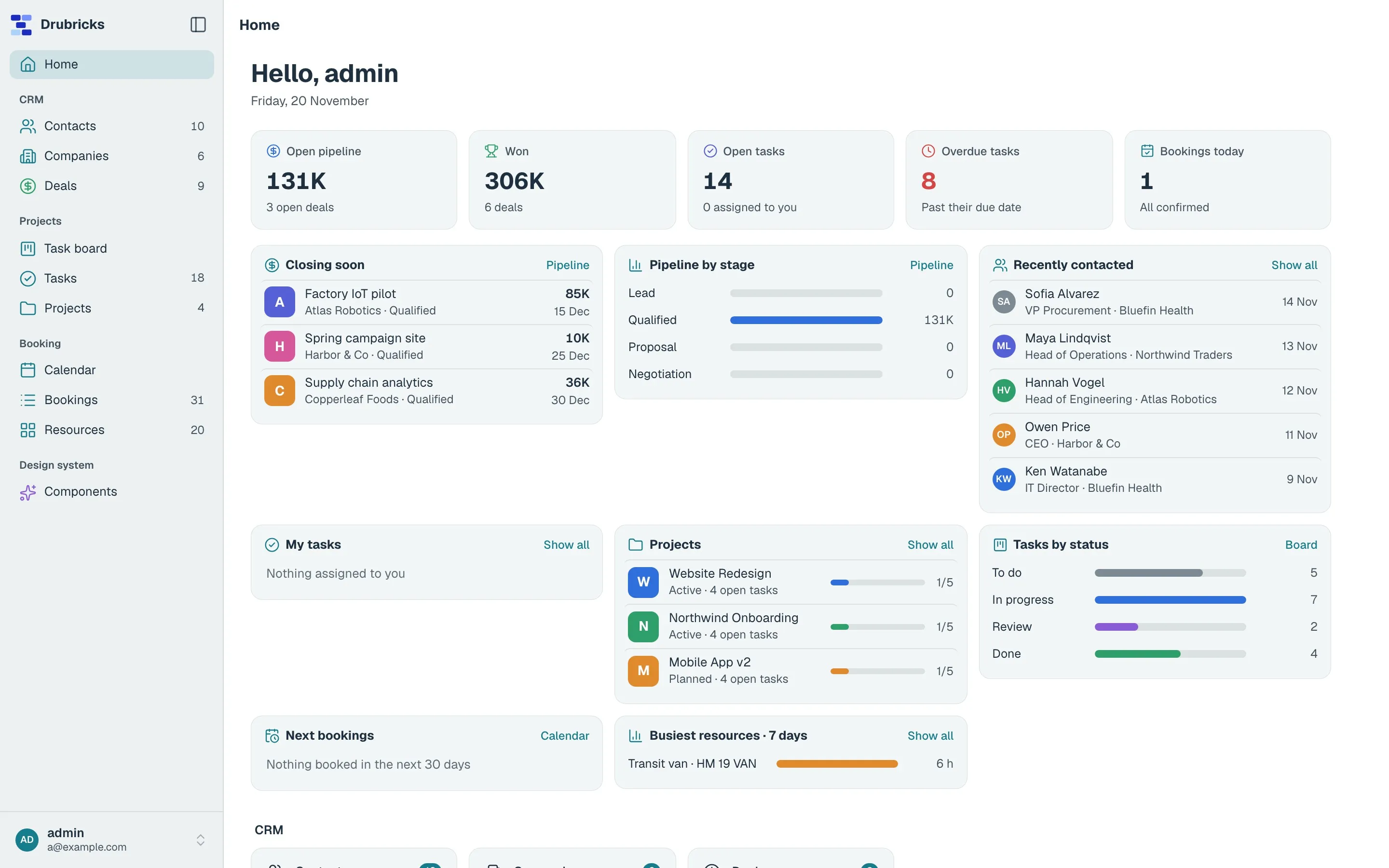
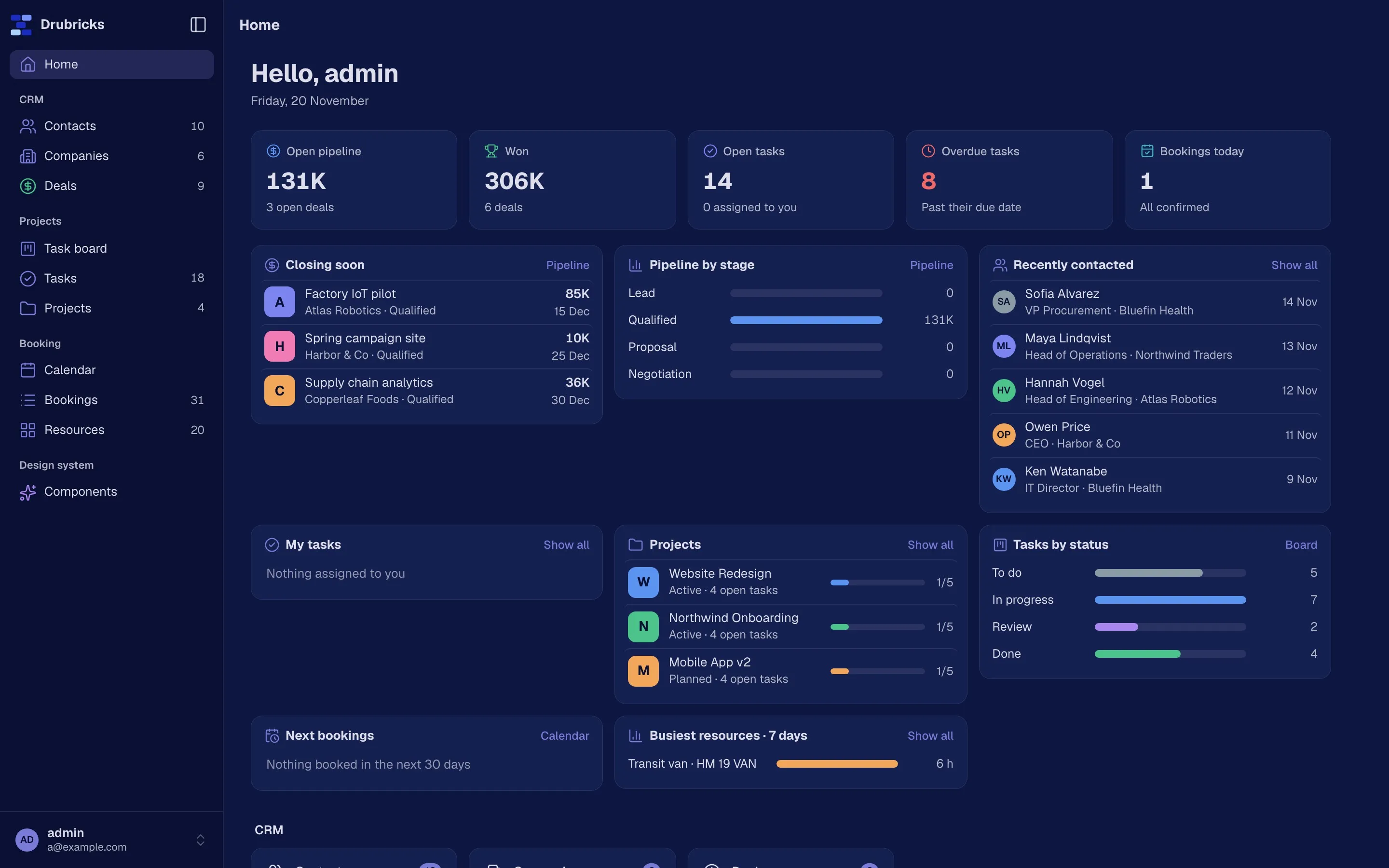
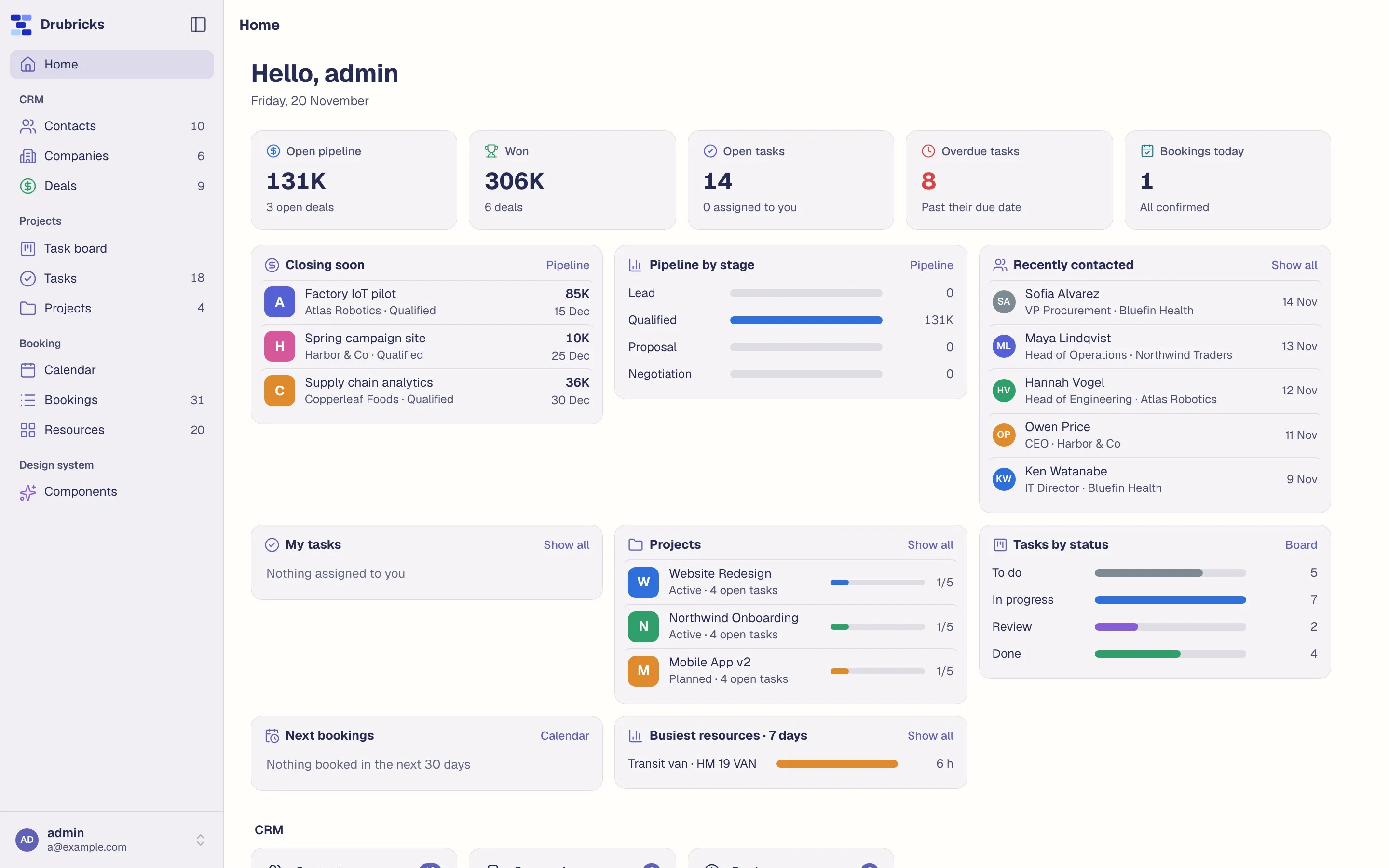
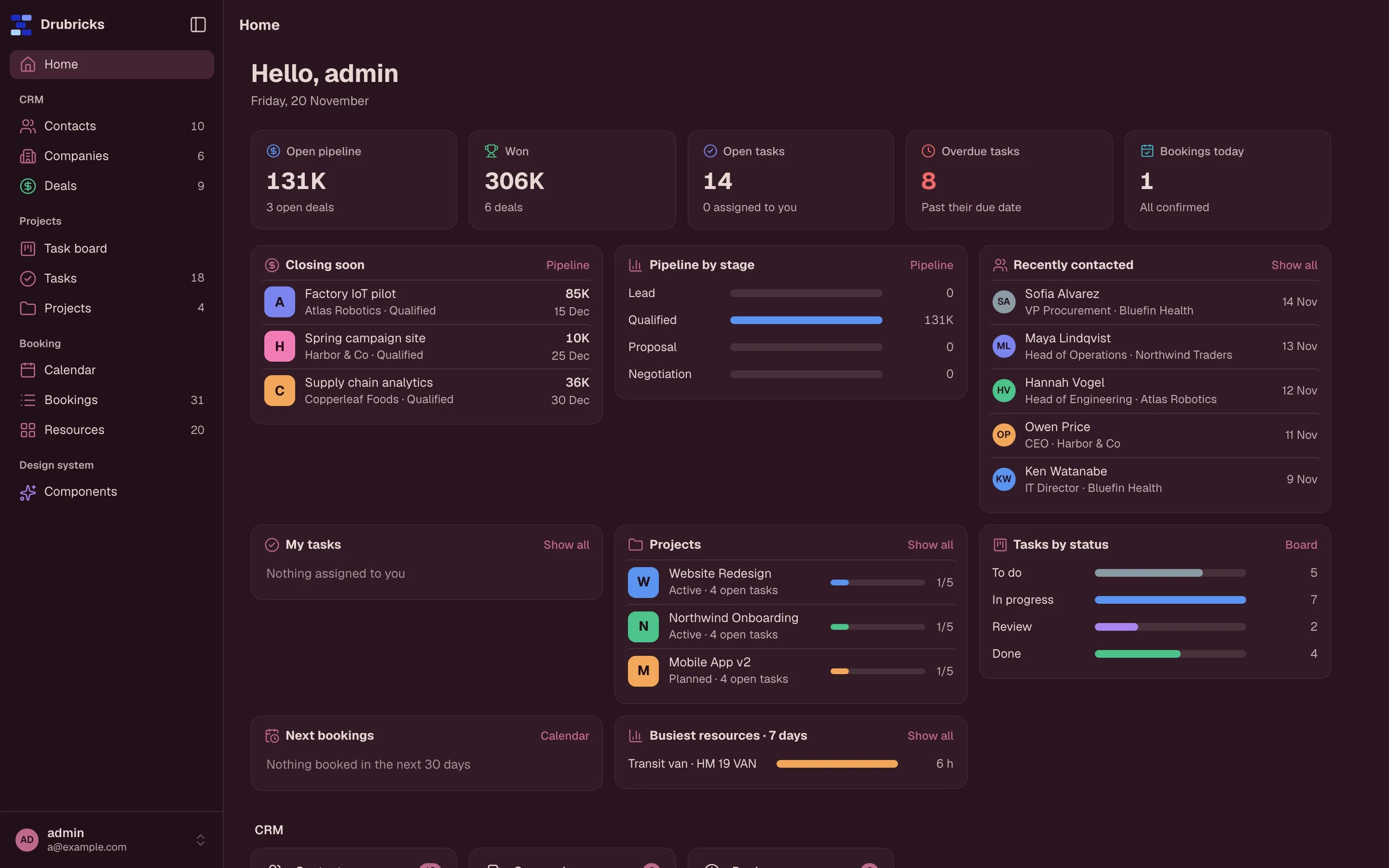
How it works
The agent follows AGENTS.md in the repository. You answer a few questions and review the result.
The agent asks 3 to 7 questions before it writes any code: roles and who sees what, the records and their fields, the main views, the rules to enforce, language, currency, name, logo, colours and demo data.
It clones the starter and runs the launcher in your-own-project mode: a new git repository, the base installed, the example apps kept in the code as references.
./launch-drubricks.sh --own-project --apps=Your system is written as modules of its own, modelled on the bundled examples: one for a small system, several cooperating ones (sales, inventory, HR) for an ERP-sized one. Each comes with recipes, demo data and tests, and the agent installs it and checks it.
web/modules/custom/<prefix>_<name>Log in and it works. Later prompts change it the same way: “add invoices”, “teachers see only their lessons”. The owner can add fields in the admin UI without code, and the screens show them.
ddev launchWhy a starter
On a blank framework an agent invents the structure from scratch every time. Drubricks gives it Drupal’s slots to fill, so the same kind of request produces the same kind of code.
What is inside
Everything a business app needs before the first feature is written. Once you start your project, it is all your code: no upgrade path and nothing to keep in sync.
drubricks_coreBase entity with owner, dates, status, colour and revisions. Own/any permissions and record-level access. The list + details + inspector screen with modal forms, boards, calendars and tables. HTMX helpers, dashboard blocks, per-record logs.
themeThe UI kit’s app shell as single-directory components. Drupal forms in the kit look. Logo, name and palette in the theme settings. Light, dark and auto.
exampleCompanies, contacts, deals. A validation rule, a dependent field, delete blockers.
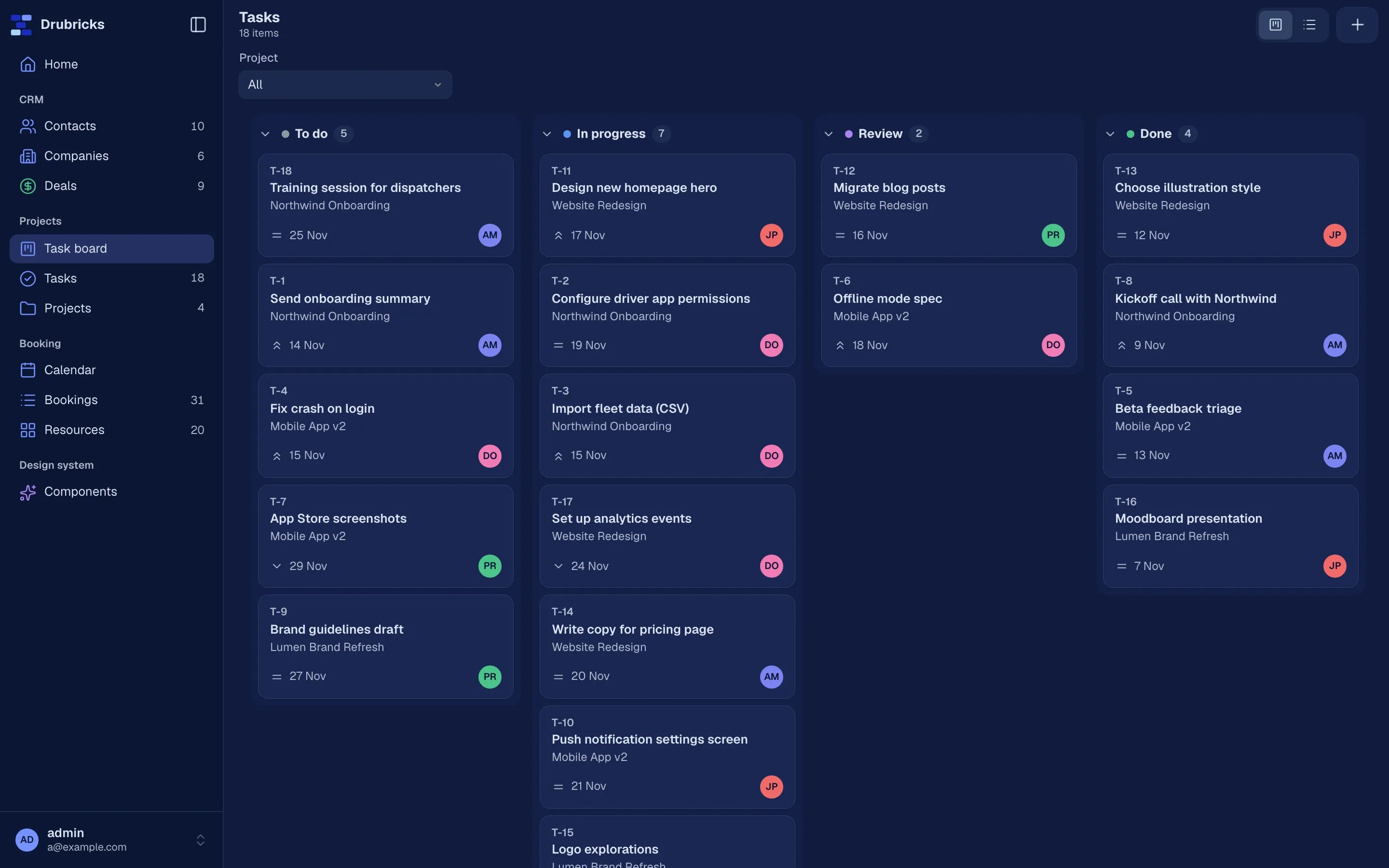
exampleProjects with members, tasks, a drag-and-drop board. Users see only their own projects.
exampleRooms, cars, equipment and people in a week calendar. No double bookings, opening hours.
AGENTS.mdHow to start a new system from a prompt, the conventions, and a drupal-way-review skill that checks every change.
installerBase recipe, then pick apps, each with its demo data. The profile removes itself.
adminNavigation, Gin Login, Masquerade, Config Log, Project Browser.
CIphpcs, PHPStan, PHPUnit and Playwright, plus an install with every app.
Stack
No legacy to drag along. A new project starts on the newest releases of everything it stands on.
Why Drupal
Business systems live for years, hold data that matters and get changed by many hands, more and more of them AI agents. Drupal was built for that.
A dedicated security team, coordinated advisories and long-supported releases. Banks, governments and universities run on it.
PHP renders, HTMX swaps. No headless split, no second build and deploy, no client state to keep in sync.
PHP with MySQL, MariaDB or PostgreSQL, from a cheap shared plan to Kubernetes. No Node.js server in production.
The framework limits what an agent can get wrong. Every entity gets the same admin UI, and the same tests run.
Roles and permissions, Field UI, Views, menus, revisions, translations. The owner changes things without a developer.
Developed since 2001 by one of the largest open source communities, with thousands of modules for SSO, workflows and search.
The interface is translated into 100+ languages, and WCAG accessibility is a requirement for core changes.
GPL, no licence fees, no platform to rent. The code and the data are yours.
Quickstart
Let the agent do it, or run it by hand to look around the examples first.
Open Claude Code, or another agent that reads AGENTS.md, in an empty folder and describe your system, naming the repository.
Based on Drubricks (https://github.com/drubricks/drubricks) build me a system to manage the teachers and clients of a language school.
The agent asks its questions, clones, builds, installs and gives you a login.
Clone into a folder named after your project and run the launcher. It sets up DDEV, installs Composer packages and asks how you want to install.
git clone https://github.com/drubricks/drubricks.git my-projectcd my-project./launch-drubricks.shddev launch./launch-drubricks.sh --own-project --apps=./launch-drubricks.sh --own-project./launch-drubricks.sh -yBlog
FAQ
Not to get started. The agent follows AGENTS.md and models its modules on the bundled examples. The code it writes is standard Drupal, so any Drupal developer can review it or take it over later.
Yes. Drubricks is open source under the GPL, like Drupal. There is no paid tier and no licence fee. The code and the data are yours.
It is made and tested with Claude Code. The instructions live in AGENTS.md, a plain file that other coding agents read too.
You don’t, by design. Once you start, the starter’s code becomes your project’s code, and there is nothing to keep in sync. Drupal core and contributed modules update with Composer as usual.
Drubricks is built on Drupal 12. Drupal core and contributed modules update with Composer, like in any Drupal project, and your project keeps receiving Drupal's security releases.
Anywhere that runs PHP with MySQL, MariaDB or PostgreSQL. Production needs no Node.js: Node only builds the theme CSS, and the built CSS is committed. Locally everything runs in DDEV.
No. Drupal renders the screens and HTMX swaps them without full page reloads. For the odd interactive widget there are JSON API helpers for small JavaScript islands.
Yes. Application → Entity structure → Manage fields. The app’s forms and record details show new fields on their own.
Copy the prompt, change the last sentence to describe your business, and paste it into your agent.